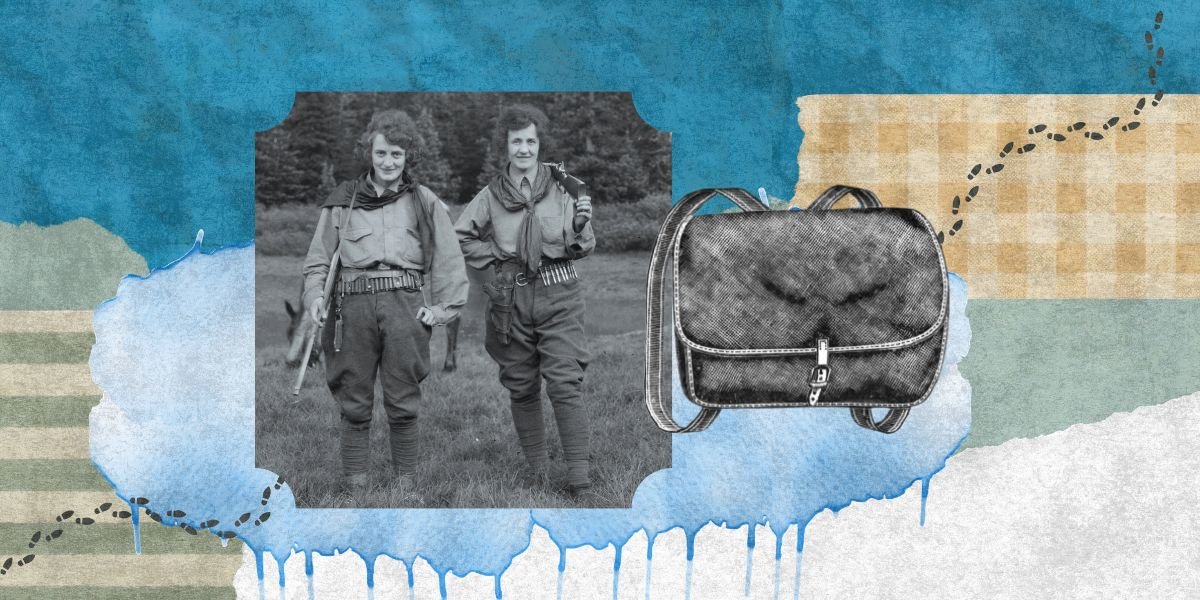
Today’s article comes from a 1909 issue of Outing magazine, written by Sara Stokes Baxter and focused on clothing options for women who want to go on long, intense outdoors adventures and didn’t know what to wear!
This was early in the outdoor/sporting goods store options and there wasn’t much available for women specifically. To add on to that, it was a time where people REALLY didn’t want women to wear trousers, even when it was safer and more comfortable! Despite that, Baxter highly recommends wearing men’s clothes, tailored for a woman’s body, and to focus on good materials that’ll last longer and be easy to clean; function over fashion (though she also take time to reassure women they’ll look good in trousers) and safety over modesty.
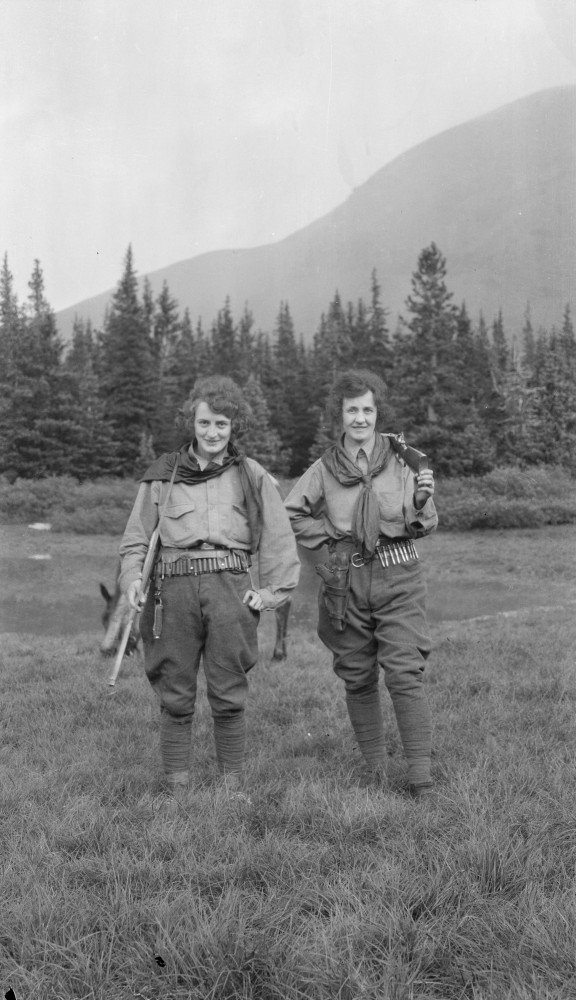
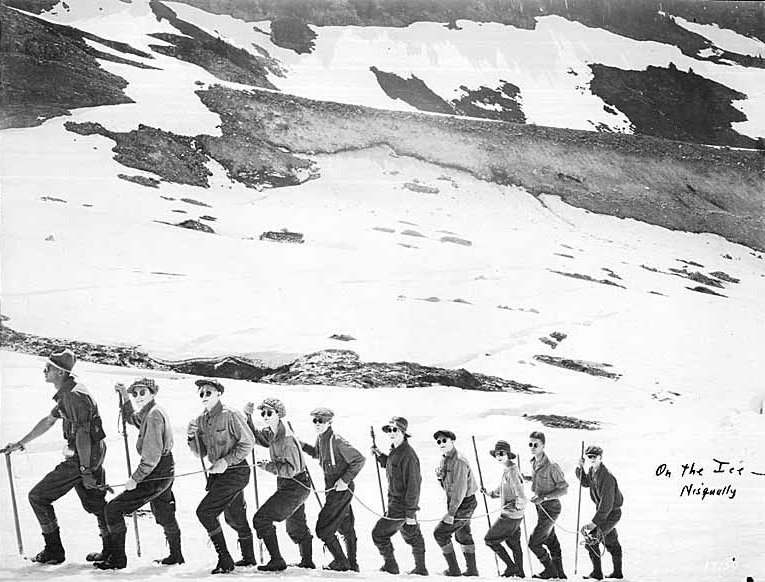
I transcribed this myself from a PDF. This article didn’t come with any photos or illustrations, unfortunately, so I tracked down some public domain images to go along with it. Enjoy!
👉 Related: “What to Wear and How to Wear It” (1920)
🌟 More Outdoors / More Fashion / More Outing Magazine
Note: Some links here are affiliate links, which means if you click on it and buy something, I get a small percentage. This money goes towards running the blog. Thank you for your support!
A Woman’s Camping Outfit
The Things That She Must Take, Those That She May Take, And A Few She Should Never Take
by Sara Stokes Baxter
WOMEN have, it seems to me, been neglected in the many articles which appear monthly with advice to campers. The road for men is made quite easy– they are told what they will need in every possible woods expedition, while women are left to their imaginations and the counsels of friends with no more experience than themselves in starting on their first trip. Many, I am sure, return with the feeling that the hardships are too great, the life too tiring, and decide upon leaving such pastimes to the men, all because they have been dressed unsuitably and their clothing has prevented the freedom of movement so necessary to enjoyment.
Of course, I am speaking of real camping in the wilds, not of a tent pitched in a grove three miles from town where a drive of a few minutes will bring one in reach of every comfort. It is my intention in this article to explain as thoroughly as possible just what the average girl or woman will find best to take as her personal outfit in the most common trips of this kind, and thus perhaps open to many the means of a pleasanter vacation than they have yet known.
The conventional clothing is in every particular unsuitable for life in the woods, so much so that no compromise may be made and one cannot start from the city dressed properly for both. The best way is to look up some quiet little town near where you are to begin the rough part of your trip, leave your native city dressed as usual for a journey and pack the camping clothes in a trunk. Then, on reaching the town you can put up at a hotel and dress, leaving the city paraphernalia in the trunk to be stored until your return or forwarded by express to some other destination. The trouble that this arrangement may seem to incur beforehand will certainly pay in the end, for the comfort of having only a few things with you, and those all practical, is not to be described.
A woman is so handicapped unless she can get around as easily as a man that she is of very little help, and must either be a drag on the whole party or become worn out. The suit which I describe here provides for the greatest freedom possible and still sacrifices nothing. It consists of coat, skirt, and knickerbockers, all of the same material. The best-looking knickerbockers are of the peg-top variety, cut like men’s riding breeches, loose about the hips and snug at the knees, where however, they are large enough to make kneeling easy. Below the knee they button in a cuff of the same material, over which golf stockings are folded.
Those knickerbockers with the very baggy knees or the still more voluminous bloomers are unbecoming to the average woman, and will not set well under the skirt. They should be like a man’s in every detail, with loops for a leather belt, and pockets, which will be found very convenient for carrying small articles. Nothing ready made will do, as boys or men’s breeches never fit a woman, so they must be made to measure. If they are ever to be worn without the skirt, the work will be done by a tailor with a much more satisfactory result than if a dressmaker is employed. There is no difficulty in this if you choose a man who makes divided riding habits for women.
As a rule the work done to order in the tailoring departments of any but the highest class sporting-goods stores is not very satisfactory and is generally high priced. A dressmaker can fit you out with what will do if you expect always to wear your skirt, but unless you or the party are strongly prejudiced, there are many times when the skirt is better dispensed with. I consider going down a rough mountain trail on foot extremely dangerous in a skirt, for no matter how short it may be there is risk of its catching on some projection when a jump has to be made. Again, it is impossible to have any pleasure trout fishing unless you can pull the waders up over the knickerbockers and are afterwards care-free as to where you go.
In many other instances it would be wise for women to overcome their objection to this unconventional way of dressing when away from civilization. A well-made pair of knickerbockers is not at all bad looking on most women, and as for the rest, the æsthetic side is soon forgotten in the added freedom. However, the skirt is so short as not to be in the way except for especially rough work; for it reaches only six inches below the knees and is worn over the knickerbockers. It is liable to look neater if opened in front with a belt of the same material sewed right on the skirt.
While the coat may make the costume more complete and look better than a sweater on many women, it is doubtful whether it is useful enough to pay for its bulk on a canoe trip or where it is necessary to go light. In case of rain a poncho, described later, takes its place over a sweater. But whenever a tramp lies through thick woods, where a sweater would catch on brambles, a coat is indispensable. If decided on, it should be Norfolk style, exactly like a man’s, with broad shoulders and big pockets, and must be large enough to slip easily over a sweater.
The question of material is very important, as, unless the proposed trip is one on which no limit is placed to the amount carried, only the suit which is worn daily may be taken. This must be adapted to the worst weather possible in your location at that time of the year– a cold snap or rainy days which may occur in most parts of our country in summer (California excepted, of course), make the selection of a heavy material the wisest. It is never impossible to wear even on hot days and may become necessary. “Loden,” a heavy imported cloth, has very good qualities. It is so closely woven as to be warm enough for winter use without interlining and comes in good colors which are somewhat mottled and thus do not show dirt.
Also it is subjected to a process which renders it as rainproof as cloth ever is, and even when wet, its imperviousness to the wind and the wool in it prevent the wearer from feeling cold. It does not stiffen on drying, and retains its shape as no material less closely woven can do, besides wearing like iron, thus leaving the future camping preparations free from any thought of a suit for many seasons. So, for general camping, I should say it was the best material if its price did not put it beyond many purses. An average of six and one half yards is required for the complete suit, the width of the cloth being fifty-six inches and the cost per yard $5.
Cloth a Consideration
Of course, any heavy woolen material may be made to serve the closest weaves and mixed colors being best, as showing dirt the least. However, for tramping through dense woods and brush, both loden and other woolen cloth will catch burs and brambles. Corduroy and whipcord have not this fault, and for such an expedition would be very preferable even though they are not as good for rainy weather. Corduroy becomes very stiff when dry, and whipcord, while not so stiff, wets through easily and then feels cold. It is impossible, I believe, to find a material which will shed burs and will be warm when wet. Beyond a doubt khaki is the best all-round material for camping in California and sections of the country where one is sure not to meet with rain or a drop of temperature during the summer months. An extra suit of this is excellent on any trip where there is no lack of room and more than one may be taken. Such is usually not the case, however.
Footwear may be our next consideration. A pair of elk or moose-skin boots, reaching to two or three inches below the knee, is a good investment. They cost from $8 up and are serviceable in most kinds of life in the woods. Even on riding trips they are better than the conventional riding boots, which fit so loosely around the ankle that the necessary walking is difficult. The tongue is sewed in on both sides all the way up, inside the row of eyes, so no water may work through. They are thoroughly saturated with oil, which makes them fairly waterproof– that is, you can walk in the rain for some time without wetting them through, but they are not proof against hours of wetting or a good soaking from a misstep into water.
Get an extra can of grease when you buy the boots, as they will need new oiling every little while to keep the leather well filled. Do not make the mistake of having hooks instead of eyelets on the upper part of the boots– they are liable to catch on the skirt. If the eyelets are not placed too near together it takes very little longer to do the lacing. Strips of rawhide are always furnished instead of strings with this kind of footwear. The soles should be heavy and the heels low. Thick stockings will be found much more comfortable, as will be explained, so the boots must be large, and should be well broken in before leaving home. A reminder is hardly necessary of what a kill-joy a pair of new ill-fitting shoes may be. However, the soft moose or elk skin adjusts itself quickly to the feet, and makes a most comfortable walking boot.
Look Well to the Feet
For mountain climbing and wherever an unusually good foothold is necessary, hobnails should be driven into the soles and heels. Besides the boots, an extra outfit for the feet should be provided. Nothing is so restful at the end of a hard day’s tramp as to change the heavy boots, very likely wet, for something else. Ankle high, laced moccasins of heavy buckskin fill every requirement in this line, and may be bought for $3 at the sporting-goods houses. One can use them with the greatest comfort all the time around the camp or in a canoe except when it rains. They are easily wet through, however, and then become extremely slippery. Otherwise, they stick to smooth rocks much better than do heavy soled boots.
With moccasins it is best to wear two pairs of stockings, or rather one pair of woolen socks, and over these long golf stockings which meet and fold over the cuffs of the knickerbockers. With the boots only a pair of golf stockings is needed. Women are foolish to avoid the rough warm stockings which men always use in the woods. They are a great protection to the feet from chafing and prevent them from becoming chilled when wet. For a long tramp they are much easier on the feet than anything thinner. Only a single change of stockings is necessary since one pair may be washed as often as desired. On a tramp a clean pair must be put on every morning and washed at night– it is well also to bathe the feet at the end of the day, and thus keep them in good condition. Two pairs of golf stockings and two of heavy woolen socks will be found right for a trip of a month or less.
Whatever waists are taken must be dark in color. White is absolutely unserviceable and not to be considered. Once worn it only takes up storage room and cannot be laundered so as to look fit to wear. Two of flannel in dark blue, gray, or brown, to match the suit, will be sufficient for a trip of any length, and if of fairly heavy material may be washed when necessary. However, if intensely warm weather is expected one waist of a dark colored linen is advisable. In case it is thought best to take two of these linen waists only one of the flannel will be needed. They may be made after any fashion desired, but a man’s negligée shirt looks well with the rough costume and allows the greatest freedom. It is, therefore, the best style to copy.
The soft turn-over collar is of the same material as the waist and made on it. A tie of any sort preferred is worn with it.The sleeves are without fullness and are buttoned at the cuffs, thus doing away with the easily lost link buttons. And here a word of warning is in place: Do not wear jewelry of any description. Rings, pins, and gold watches are very foolish possessions in the woods. These should be left at home and a dollar watch bought.
A gray felt cowboy sombrero makes a serviceable hat. When not in use it is easily stowed away in a very small space without the least injury. It will cover the hair completely in case of rain and may be pulled down on any side to shade the eyes when the sun is troublesome. As a rule it looks well pinned up on one side. An elastic sewed on it and worn under the hair in back (just as children do) will be found a better means of keeping the hat on securely than the use of hat pins, also far less dangerous in case of a fall. A good way to wear the hair for this is to tie the pompadour firmly on top, braid the rest, roll it up and tie again at the neck. It may be so arranged in the morning for all day with no further need of attention and necessitates no hairpins or side combs. On especially windy days a ribbon bound around the head will keep the loose hair out of one’s eyes. In this way a woman stays in as good trim as a man, and need not have her personal appearance on her mind.
The question of underclothes is very simple. No corsets of any kind should be taken and no lingerie. Men’s or boys’ style underwear should be worn, preferably in two pieces. Three suits will be plenty, and in general it is advisable to have two of these medium weight. This is warm enough for the average cool day in summer, and two suits may be worn at the same time if necessary. The third should be either very heavy winter weight or the lightest summer weight according to the time of year and the climate. Both will never be necessary.
Now for the extras which you may or may not wear often, but which must always be taken except under very unusual conditions of climate. A sweater is one of these, and a good heavy one is the only kind worth having. As most people know there are two styles from which to choose: that with the high neck more generally worn by men; and that which buttons in front and is cut out at the neck. The latter is much more convenient for a woman to use, as it does not have to be pulled on over the head. It may be wisely chosen when there is need of something to slip on and off easily for extra warmth in the morning and evening, and seriously cold weather is not expected. In our Northern woods, however, even in summer, there are days when the heavy high-necked sweater is gratefully tugged on the first thing in the morning, and removed reluctantly at night. At such times the jacket would be entirely insufficient. The warmth of the wool snug around the neck is the greatest comfort and compensates for the difficulty with which the sweater is put on.
The poncho pays best of all for the room it occupies when not used, because by keeping one dry when it rains it prevents the necessity of taking changes of all other clothing. The old-style poncho was simply a heavy rubber blanket with a slit cut in the center to admit the head. It is used in the army and is very good for horseback riding, since the reins may pass underneath it and the hands are thus kept dry. It is useful, too, where a rubber blanket is needed, but this is not the case if the tent and duffle bag, which I will describe, are used, and the new adaptation of the old poncho, known as the rubber or automobile shirt is better for general camping purposes (sold at most rubber and sporting-goods houses for from $5.50 to $9– a good quality being best in the end).
It is made of very light rubber, packs into a small space, and has sleeves with elastic wristbands so that the arms are perfectly free and dry. The neck is finished in various ways, but always with a standing collar to fit close. It goes on over the head just like the old-fashioned poncho so as to avoid any more open space than is necessary, and is made large to fit anyone. It should be long enough to reach well below the tops of the boots which are always worn instead of the moccasins in the rain. Dressed in this way, with the felt hat entirely covering the hair, one may be out in the rain all day without the slightest discomfort. This is perhaps a new idea with the average woman.
Incidentals to Think About
Gloves are not necessary, except on a riding trip, unless the weather is extremely cold. But an old pair of heavy kid will be found convenient to use while cooking over a camp fire and in handling hot kettles. For handkerchiefs, a couple of white ones may be taken, but the constant washing necessary to keep them presentable will make the bandanna much more popular with most people. This is a valuable institution, for it may be used as a napkin at table, as a towel when the real ones are packed, and as a covering for the head worn pirate-fashion on a windy day– all this, besides its obvious use as a handkerchief. Two of these will be enough.
Perhaps the cold nights in the woods will present another problem to the inexperienced woman. Again it is simply a case of copying the men, who seem to have the only clothing suitable for camping. A pair of heavy woolen pajamas held down with the extra pair of golf stockings pulled up over the legs are the only practical night clothing. If you can depend on the weather being mild every night, the pajamas could be made of thinner material, but a woman’s nightgown is out of the question. It may seem strange to advise only one pair of night clothes for a month’s use, but when one realizes that one pair may be kept as clean as six, if washed as often, the wisdom of carrying the smaller number is evident.
The underclothes, stockings, handkerchiefs, and sometimes the waists must all be washed, if the number I prescribe of each is adhered to. Should any cover for the head at night be thought wise, a boy’s toboggan cap, with the tassel cut off, makes an excellent nightcap and covers the ears. Even though going with a party by whom other parts of the equipment are supplied, you may be called on to furnish your own sleeping outfit. A woman who is not used to roughing it may find the ground hard even when boughs or moss are used to soften it. There are two ways of overcoming this if the trip allows the extra equipment. An air mattress is very comfortable but requires a pump and the bother of blowing it up, and costs from $21 to $27– secondly, a folding camp cot costs $2.50 (at all sporting-goods stores) and is not quite as soft. For a permanent camp, instead of either of these, one may take a bag of ticking shaped like an empty mattress, 6 x 2 1/2 feet, and fill it with grass, leaves, or moss.
Of course, those who find it easy to sleep under any conditions will scorn such luxuries, but a good night’s rest is important or no benefit is derived from the trip. An empty pillow case of dark-colored denim may be filled with a sweater and other soft clothing to make a good pillow. For covering, two heavy double blankets, narrow width, will generally be sufficient. They may be pinned together down both sides with large horse-blanket safety pins, thus forming a bag, open at one end.
If the tent has a floor nothing need be provided for covering the bedding. By all means have this convenience if possible. The floor is made of heavy brown waterproof canvas sewed to the walls of the tent on three sides, the front being left free and fitted with a sill six inches high. The result is a perfectly dry tent at all times, a comfort which I would put above that of being able to build a fire inside, and is a protection against snakes and everything that crawls. The bedding may be laid out on the floor and rolled up with the tent when camp is moved, thus keeping it entirely covered with waterproof material. It is rarely necessary for a woman to make a decision on tents, cooking outfits, etc., since the men of the party would naturally attend to such matters themselves; however, should any information of this kind be desired, I would refer the reader to “Camp and Trail,” by Stewart Edward White, and to “Camping and Woodcraft,” by Horace Kephart.
Finally, we may consider the numerous toilet articles and the best way to carry them. If there is possible space for it, one dark-colored Turkish towel is fine, especially if there is to be any swimming. Lacking the room, one dark-colored towel of crash will be all that is needed. Hand mirror, comb and brush, tooth brush, nail brush, soap, wash cloth, and tooth powder in a metal box (not glass) may be carried conveniently in a rubber toilet case, procurable at drug stores, or in small waterproof provision bags sold by the sporting goods dealers at about fifteen cents apiece. One of these bags may also be used to hold whatever medicines are thought necessary, tablet form being the most practical.
Suit cases and valises are entirely impracticable for use in the woods, even in a permanent camp. They are not waterproof, are too ungainly to pack well in a given space, take up too much room for the amount they hold, are too heavy when empty, and will not stand the banging and rough wear they are sure to get. A duffle bag of brown waterproof canvas answers every requirement, and may be checked on the train anywhere.
There are other things readily thought of by each woman which she will want to add to this list. They are not general though, and some will want them where many others will not. I speak of such things as notebook, kodak, fishing rod, rifle, etc. However, the personal articles which each one needs during a month or more of woods life have all been considered I believe, and thus prepared, I think, many women could enjoy to the full such a vacation.
Transcriber’s Notes
- Duffle is an alternative way to spell duffel (and is not a typo).
- Kodak was lowercase in the original text, though it IS a brand name and should’ve been capitalized.
- Loden is still a very niche fabric and I’ve certainly never seen it IRL, but it CAN still be bought and you can find pre-made clothes made from it (mostly coats, seems like). Here’s an article about the history of loden from Permanent Style.
Sources
Stokes Baxter, Sara. “Woman’s Camping Outfit.” Outing magazine, vol. 54 Apr-Sept 1909, p634-638. PDF from HathiTrust: https://hdl.handle.net/2027/coo.31924066344981
Photo: “Two women on a trek with rifles and cartridge belts.” Mountain Park, Alberta. Provincial Archives of Alberta. From the Godby Family fonds, PR2009.0441/0098. From Provincial Archives of Alberta on Flickr Commons: https://www.flickr.com/photos/alberta_archives/29844292204/in/photostream/
Photo: “Climbing guide Fairman B. Lee with a party of hikers on Nisqually Glacier, Mount Rainier.” Photograph by Frank Jacobs and Fairman B. Lee. From University of Washington on Flickr Commons: https://www.flickr.com/photos/uw_digital_images/4326185910/
Backpack drawing in header from Abercrombie & Fitch 1907 catalog: https://archive.org/details/AbercrombieAndFitch1907Catalogue/page/n131/mode/1up