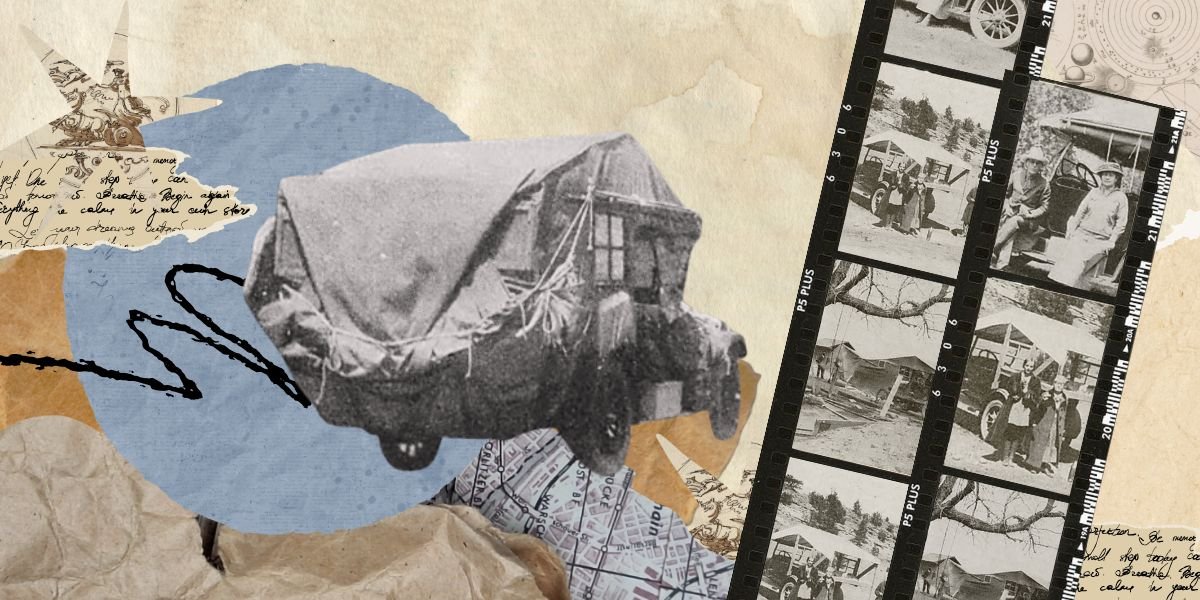
This is an article from Outing magazine from April 1923 (no named author); it’s about how one guy modified his 1920 Franklin touring car into an early version of an RV! It’s got a lot of details about the specific modifications he made and a little about how he traveled for 4 months around the US in it, but not much on the actual camping experience or if he and his companions enjoyed it. I suppose they did, if they kept at it for four months straight.
I transcribed this article from a scan provided on HathiTrust and cropped the photos from the photo page to include with the article (link in the Source section at the bottom of the post). Enjoy!
🌟 More Outdoors / More Outing Magazine / More 1920s
Note: Some links here are affiliate links, which means if you click on it and buy something, I get a small percentage. This money goes towards running the blog. Thank you for your support!
Living in the Car, originally published 1923
THESE are motor camping days. The market offers endless variations on outfit, trailers, tonneau beds, tents, tent beds, and all variations on each one.
And then there are the people who like to make their own living quarters for their days on the road. One of them is Mr. Harris T. Dunbar, of Buffalo. His car, which he calls a “Locomotel,” or a cross between a locomotive and a hotel, is a 1920 Franklin touring car. No fundamental changes have been made in it except such as are involved in the removal of the top and the installation of a set of auxiliary coil springs.
A frame coil was added after the standard top was removed, carrying a new type of top and including a shelf, which extends back three feet from the back of the tonneau. The front crosspiece of this new top is fastened to the windshield, in much the same manner as the ordinary top and two truss rods run forward to the bumper castings. There are two other rods that run from front to rear over the peak, so spaced and shaped as to transfer the load forward and keep the top from swaying. The back panel is strussed by two diagonal straps, which are removed at night.
The peak is supported by two posts fastened to the fenders at the lower ends and supported in turn by two iron straps that run to bolts that have been put in place of the bolts that carry the standard top. A seven-inch by one-inch piece of oak is held against the back by eyebolts, the eyes fitting the bolts that hold the folded top bows in place in the standard construction. Two stout hooks, fastened to top of back and bottom of oak, carry the load. There was no disfigurement of the car except such as is involved in cuts in the upholstery and about twenty 13/16-inch holes in the flanges of the fenders.
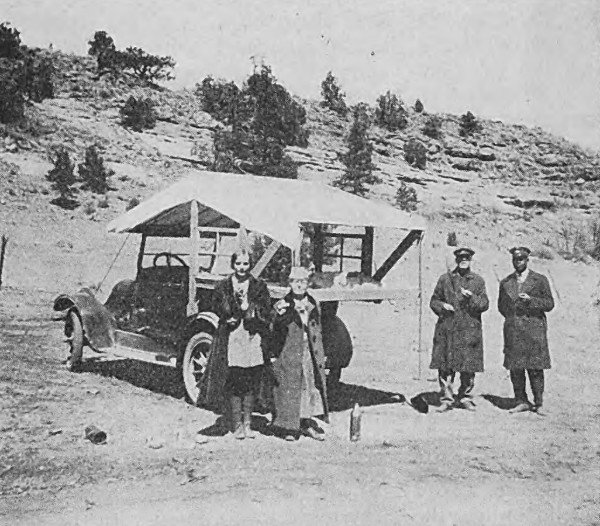
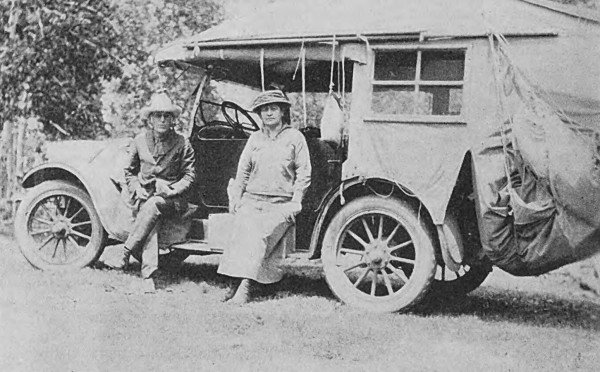
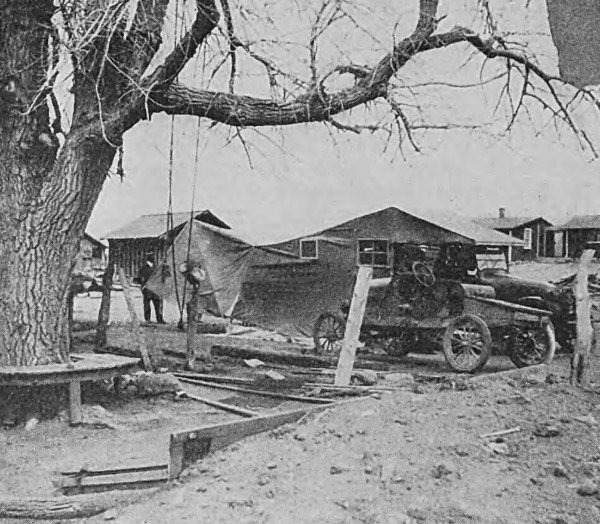
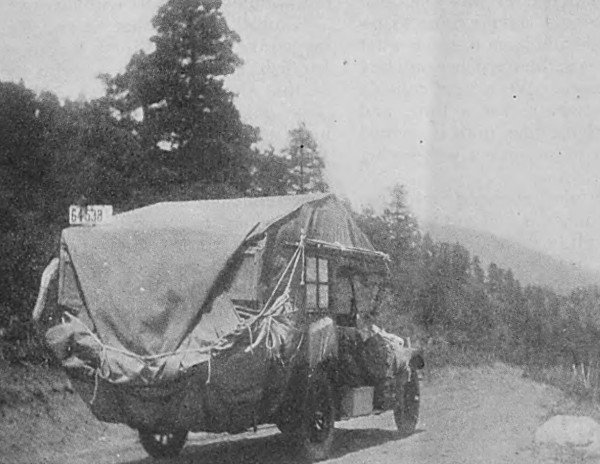
However, details of construction are not as important as results. The photographs give a general idea of how the thing was done. Mr. Dunbar made the changes himself with the help of his chauffeur, a blacksmith, a planing mill, and a tent maker. Different men and different cars will bring different solutions of the problem.
The points to consider are how Mr. Dunbar has made the completed Locomotel serve all the needs of travel, sleeping, eating, and living in general. When the car is in camp the canvas at the rear opens out to form an open-ended shelter, eight feet four inches by nine feet six inches on the ground. The least height is six feet. The shelf at the rear of the tonneau extends into this compartment, which was used as kitchen, dining room, and cook’s bedroom. The pantry comprised twenty-three small bags which hang under this shelf. The table with legs removed hangs behind the shelf. The equipment includes the usual assortment of tools for repairs, axe, block and tackle for bad road emergencies, water bags, lantern, gasoline stove, spare parts, etc., not forgetting to mention the nine bathtubs. Butter was kept cool, even at 100 degrees, in a stone jar wrapped in a wet cloth to insure evaporation. There were also an ice-box, a bread-box, and under the cowl a shelf containing the library. Water is carried in two ten-gallon cans, one on each running board. Drinking water is carried in a two-gallon Colorado waterbag and is kept sweet and cool by evaporation, as in a Mexican jar.
When the car is on the road the bed for the “master’s room,” that is, the tonneau, is hauled up to the roof, ready made up. The rope and pulleys that haul it up are supplemented by a bar that slips under it when in place. All that is necessary when bedtime comes is to let it down and crawl in. Air mattresses insure sweet dreams. This bed is full length and five feet eight inches wide. The cook-chauffeur sleeps in the rear compartment formed by the extended canvas. A spare tent can be carried to take care of two extra passengers, for whom space is provided in the car. The whole outfit can be set up in ten minutes after the car stops and be on the road in fifteen minutes after the last dish is washed.
The tent part of the outfit is supported on four poles and can be set up on solid rock. For overnight stops no pegs or sidelines are used, only a line from each top rear corner to the ground, to guard against squalls.
Last year Mr. Dunbar lived in the car for four months through all kinds of weather and over all kinds of roads. He traveled three thousand miles, from Buffalo as far west as Cheyenne and back, making all the detours his fancy dictated on the way. The actual mileage per gallon varied with the degree of badness of the roads, but the average was close to eighteen. The car loaded weighs 4,500 pounds and the total cost of the changes and new equipment was $500.
What man has done man can do.
Transcriber’s Notes
- More about what a tonneau is on Wikipedia here; basically it’s the passenger seat in the back, I think?
- Here’s a 1919 Franklin series 9B touring car to give you can idea of what they were working with
- $500 in 1923 is equivalent to just under $10,000 in 2026 money (per CPI Inflation Calculator)
Source
“Living in the Car.” Outing Magazine, April 1923, p18, 46-47. PDF from HathiTrust: https://hdl.handle.net/2027/coo.31924066337399