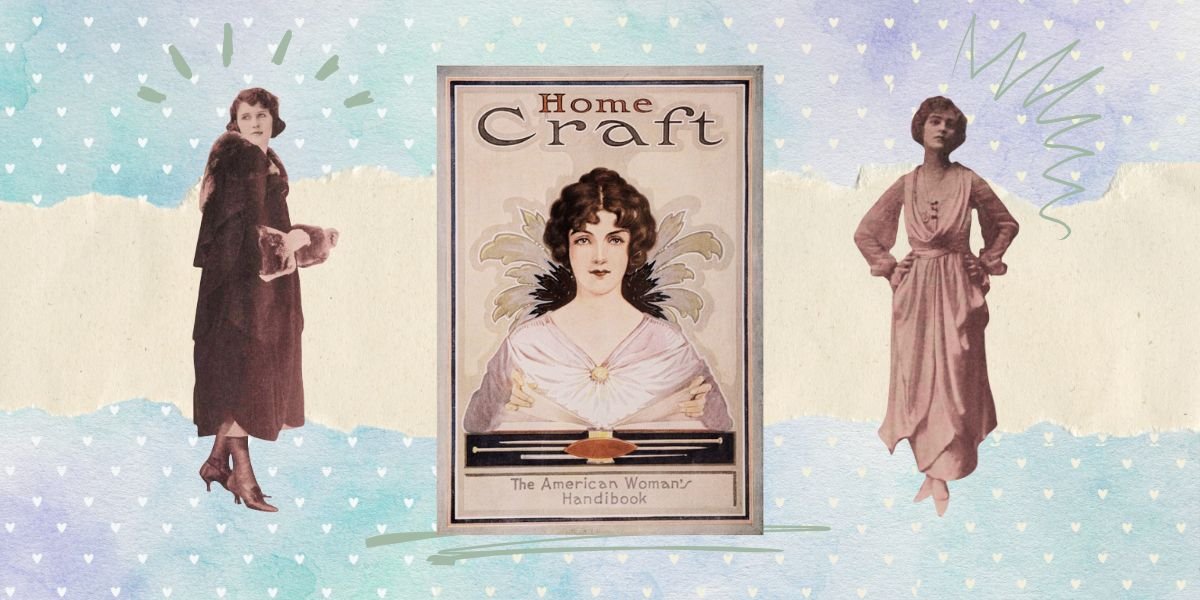
This is an article from the book Home Craft, published in 1920. It’s one of those “books for housewives” things where they cover all sorts of home ec topics for running a household, but this one ALSO includes quite a bit on fashion. This article focuses on giving advice for what to wear re: colors, styles, fabrics and so on, and then goes into a little etiquette at the end (don’t wear fancy clothes out in public, basically!).
A lot of this advice is the same stuff you’ll hear today, funnily enough. There’s quite a bit of talk about what “stout” women should and shouldn’t wear, and you may not be surprised to heard that horizontal stripes are bad but vertical ones are “slimming.” Anyway, it’s a peek into how people thought of clothes in the earliest part of the “roaring twenties.”
I transcribed this myself (no AI) from a PDF scan provided by the Library of Congress. The source link is at the bottom of the page. Happy reading!
👉 Buy a physical copy of Home Craft (1920) on eBay
🌟 More Magazine Articles / More Roaring Twenties / More Vintage Fashion
Note: Some links here are affiliate links, which means if you click on it and buy something, I get a small percentage. This money goes towards running the blog. Thank you for your support!
What to Wear and How to Wear It, by Frances Drake
THE art of good dressing lies in choosing garments both becoming to the wearer and suitable for the occasions on which they are worn. Our first thought in looking at a new is usually in relation to general appearance. And appearance comprises so many other items:—becomingness, fit, suitableness and general effect of line and color. One of the serious mistakes a woman makes in selecting a costume is to make her decision without due consideration of the use to which the new garment will be put and also whether, quite aside from the beauty of the costume in itself, it will enchance the appearance of the wearer. Material must also be taken into account since women who, for instance, cannot wear black when that color is used on a heavy woolen goods may be most attractive in black chiffon crepe. Extremes of style may be enjoyed by women who can change their wardrobe continually but the average woman whose more expensive garments must be worn for more than one season should avoid both style and material of very pronounced type.
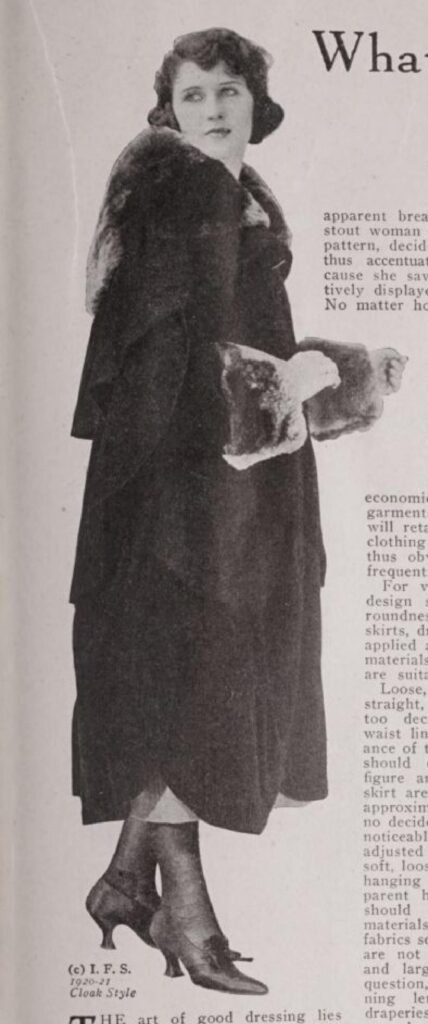
Many a costume, lovely in itself, fails to produce the effect desired merely because the purchaser has not taken the personal equation into consideration. In choosing a garment be sure that it suits the person by whom it is to be worn. The stout, short figure needs long lines, the over-tall, slender woman requires styles calculated to increase apparent breadth. Too often we see a stout woman wearing a gown with large pattern, decided plaid or cross draperies, thus accentuating her width, merely because she saw a similar garment attractively displayed on a tall, slender model. No matter how popular a style may be, never adopt it unless in is becoming to your particular build and coloring.
Simple designs are best for the home dressmaker and a pattern should be used that is easily followed. While simple designs often suggest expensive materials for their development, such designs need a minimum of yardage and are therefore economical in the end. Moreover garments made of good materials will retain their shape longer than clothing made of poor goods and thus obviate the wear and tear of frequent pressing.
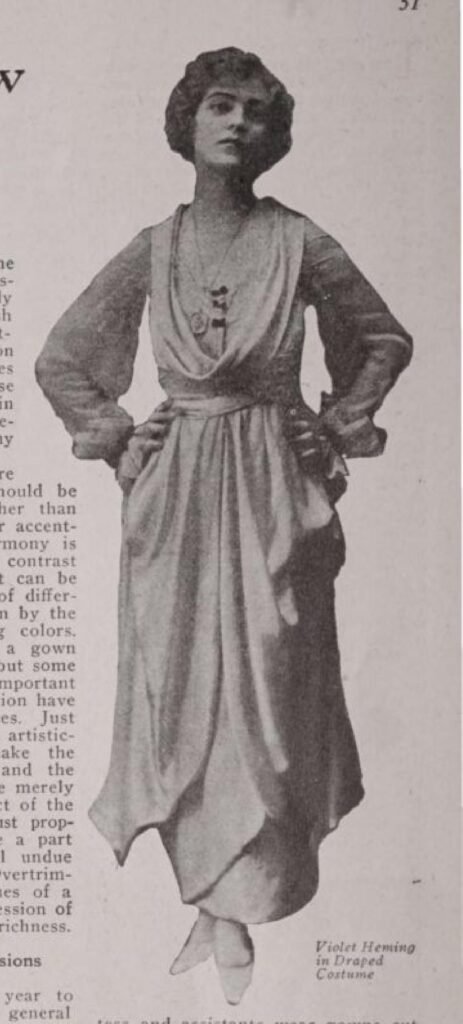
For very tall, slight people the design should be one to suggest roundness. Soft, full blouses, full skirts, draperies, flounces and bands applied across skirt and waist; and materials heavy enough to add bulk are suitable.
Loose, easy-fitting garments with straight, unbroken lines and a none too decided accentuation of the waist line will improve the appearance of the stout woman. No lines should carry directly across the figure and if blouse and separate skirt are worn, these should be of approximately the same shades so no decided break in the line will be noticeable. A surplice waist, bodice adjusted to fall over the skirt and soft, loose draped girdles with long, hanging ends, help increase apparent height. The stout woman should choose soft, non-lustrous materials, for the stiff, glittering fabrics so effective on her tall sister, are not becoming to her. Plaids and large figures are out of the question, but narrow stripes, running lengthwise, and lengthwise draperies or flat-sewed, group tucks, are becoming. Brilliant colors should be avoided as they make the lines of the figure stand out sharply. Greys make a stout figure look stouter, but taupes, dark blues and plum shades are effective and give her a variation from the somber black so smany tout women affect.
Choice of Color
COLORS should be chosen in relation to the eyes, complexion and hair as well as of the figure. As a general rule we find that women with fresh, clear coloring have a of wider range of colors from which to choose than have their paler or sallow sisters. The woman who must needs be limited in her wardrobe will get better results if she chooses one color for a season so hats, wraps, hose and gowns will all harmonize, since a coat, accessories and hat for each differently colored gown is beyond the purse of the average woman. Dark blue is a universally becoming color; many types can wear brown and cream shades, and taupe is most attractive for the elderly woman. Bright reds, greens, yellows and medium light shades of blue look better on the youthful, slender figure than on the average woman past middle age, and nothing makes a woman look older than being dressed in costumes of too youthful cut and too vivid color. The neutral tones, soft pastel shades, soften the complexion and while they are attractive on the young girl, are almost essential for the elderly woman who does not wish the signs of age accentuated. For the same reason that an older woman chooses soft colors she should use soft materials and when in fashion, nothing is so becoming as white or creamy lace near the throat line.
When bright shades are used as trimming they should be placed near the face, rather than on the hem of the skirt or accentuating the belt line. Harmony is rather to be sought than contrast and as a rule better effect can be obtained through the use of different tones of one color than by the use of sharply contrasting colors.
We all appreciate that a gown must fit well to look well, but some of us fail to realize the important part that finish and decoration have in the effect a gown produces. Just as the general lines of an artistically designed building make the chief appeal to the eye, and the architectural decorations are merely an emphasizing of the effect of the building as a whole, so must properly applied decorations be a part of the frock and not call undue attention to themselves. Overtrimming usually spoils the lines of a garment and gives an impression of fussiness rather than of richness.
Dress for Various Occasions
AS styles change from year to year only the most general statements can be made on appropriate dress for any specified occasion. A few years ago a wedding dress had to have a high collar, long sleeves and sweep the floor and while ball gown style is not even now in vogue, the wedding gown with short sleeves, skirt far from the ground and the throat cut low as any afternoon gown, is proper.
Theoretically, a man wears full dress to any function after six o’clock at night, if ladies are invited, but many dinners, theater parties and after-theater suppers are now conducted informally permitting the “tired business man” to come in his business suit. This is certainly not objectionable were the women of the party dressed to harmonize, but instead of wearing attractive afternoon clothes, many women appear in full dress, looking, by comparison, far more out of place than the men of the group.
In the street, elaborate dress is always in poor taste, and the woman who wears gorgeous clothing on the street should have her limousine in which to wear it. Women of unquestioned social position wear inconspicuous clothing when shopping or in any promiscuous crowd. They appear in simple tailored suits, hats of moderate size, walking shoes with sensible heels. In the afternoon a light gown may be worn under a long coat, or a tailored suit, the jacket covering the fancy waist. Such costume is proper for concert, matinée or reception and with dressy shoes and white gloves complete an appropriate garb. Costume for church should be simple and quiet as for shopping. Jewels, except a simple brooch and perhaps a ring or two are never in place in the daytime, except at very formal receptions where appropriate costume is worn and covered when on the street.
At a daytime reception the hostess and assistants wear gowns cut moderately at the neck and guests wear street costumes of cloth.
Full dress means low neck and short sleeves or sleeveless gowns and is worn at balls, opera, dinners and other formal evening entertainments. The average American woman does not wear full dress to the opera or theater unless she is seated in a box or or is one of a party who all come in full dress from a dinner, or expect to go on to other functions afterward, in which case her shoulders are usually covered with a scarf of thin material like malines or chiffon while in theater.
A man wears a plain business suit, cut according to the prevailing fashion for his working hours, and is modest as to colors in shirts and ties, hats, socks and handkerchiefs. Nothing so quickly betrays a man’s lack of “costume sense” as a weakness for brilliant hosiery, over-brilliantly polished shoes or vivid waistcoat.
When a man sheds his coat for sports he must wear suspenders that fasten underneath his shirt and not the visible variety. Since these suspenders have come into vogue and men wear belts with them on very hot days many men do not wear their coats to table, but while the habit has the sanction of custom in many places, strict etiquette demands a coat of some sort (black habitui or natural color pongee are very thin) and a coatless man must not seat himself at table when strangers are present without obtaining their permission. Many hotels do not permit men in the general dining rooms without their coats being worn.
A man assumes evening dress on the same occasions that the women of his party wear full dress and there is a conspicuous absence of jewelry from his costume except his dull gold, pearl, or white enamel shirt studs, dull gold sleeve links and perhaps his watch fob.
The dinner jacket or Tuxedo is worn only at informal dinners, at stag dinners, or at theater when not with a theater party including ladies.
Transcriber’s Notes
Words that look like typos but (probably) aren’t:
- enchance
- malines
- Tuxedo with a capital T
Source
Drake, Frances. “What to Wear and How to Wear It,” from Home Craft: The American Woman’s Handibook (Chicago: The Magazine Circulation Co., Inc., 1920). Page 59. PDF from the Library of Congress: https://www.loc.gov/item/21001185/
Images are from original article
Vintage Fashion
No posts