I was looking for picnic menus and came across this nifty artifact: a broadcast transcript for a USDA radio show called Housekeepers’ Chat!
“The fictional character Aunt Sammy—a relative of Uncle Sam—hosted the show, though she was voiced by local anchors who added their own accents and personalities to the official script distributed by the USDA. Broadcasts targeted rural women with advice about food and nutrition, gardening, and pest management.” (from Internet Archive collection page)
This specific transcript is for a show about picnics! It includes some ideas on how to prep for a picnic, a menu, and some ideas for putting together a picnic set inexpensively. There’s also a suggested related bulletin, “Cooking Beef According to the Cut,” which is a USDA publication and has a recipe for one of the main dishes mentioned in the broadcast. I’ve included that recipe at the end of the post, as well as source links so you can download the PDFs for yourself if you want. Enjoy!
🌟 More Picnic Stuff / More Outdoors / More USDA
Note: Some links here are affiliate links, which means if you click on it and buy something, I get a small percentage. This money goes towards running the blog. Thank you for your support!
Housekeepers’ Chat (May 22, 1929): When We Eat Out of Doors
Do you remember, years ago, when a picnic was an annual event? You looked forward to it, for weeks and weeks. Mother washed and ironed your prettiest flower-sprigged muslin frock, and your white embroidered petticoat in honor of the occasion. The morning of the picnic you laid our your Sunday pair of white stockings, your patent leather slippers, and the big hat with the blue ribbon streamers.
And then, what happened? Like as not, it rained; a slow, drizzling, teasing rain — the kind of a rain which can never quite make up its mind whether to come on down and get it over with, or to stay up in the clouds till noon. Could anything be more tantalizing on the day of the annual picnic? With nose pressed against the cold window-pane, you shed a few tears in self-pity.
But picnics have changed — they are no longer “annual” events — they’re two-or-three-times a week events. Modern picnicking is so easy that it’s becoming a habit in lots of families.
Let me tell you how a mother in Arkansas plans her family picnics, so that they are a joy to every member of the family: “The chief reason why we can picnic comfortably,” she says, “is that we have the equipment. Our folding card table slides behind the coat rail of our car. The folding camp chairs, with backs, lie on the floor between back and front seats, and the thermos jug of ice and water fits down in the chairs. Plenty of room is left in the back for the big lunch basket and a pair of adult feet. The children’s feet fit above the stools and basket. Our table, and chairs for four cost less than five dollars, and what a difference they make!
“Our menus are simple, and can be the same whether we eat at home on the porch or out in the open. We try not to take more food than we shall eat. Emptied mayonnaise and fruit jars are used to carry vegetables, fruits, butter, sugar, etc. If something hot is planned, we carry it in a small electric cooker, or in a pan well wrapped in newspaper. Milk for the children is carried in the milk bottle. If sandwiches have not been prepared, each one spreads his own bread. The easier the preparation, the more mother enjoys her supper. Here is a typical menu which has proved highly successful for guests as well as for the family, and which is undeniably easy to prepare: Sliced meat loaf, hard-cooked eggs, ripe tomatoes, cinnamon rolls, pickles, milk, iced tea, and cakes.
“There is plenty of room in the car for “bean” bags (they won’t roll if we stop on a slope), and for a ball and bat, and the whole family gets exercise and relaxation which they would not get at home. When we are going to eat beside a stream, a towel and extra union suits for the children are taken. They will surely want to wade, so why not be prepared?
“We have some favorite picnic spots, and when there is time, we love to explore inviting side roads till we find a cleared, secluded place big enough to set up camp. There are some easily accessible places near town to which we can go if our tine is limited. When we go near by, it takes little more time to go out for supper than to eat at home.
“A little baby is contented during supper lying on a seat in the car, protected by mosquito net. A baby big enough to sit up but too small to eat at the table is happy on a cover on the ground, or in his swing hung from a nearby tree. A child old enough to run around revels in the freedom from yards and walks and fences. Picnics like ours are a rest and a joy to the whole family.”
That’s all. I’m glad this Arkansas mother finds room for such paraphernalia as balls and bats, and beanbags. By the way, bean bags made of oilcloth would be fine on a picnic — falling into the brook wouldn’t hurt them a bit. They might be made of table oilcloth in the new checks or colorful plaids. Did somebody ask for Christmas suggestions? But I must keep my mind on picnics.
Another mother I know of finds a “picnic comer” her salvation, when the children decide suddenly that they want to eat down on the beach or out in the woods.
“In my picnic corner,” she says, “I keep, first of course, the containers. Recently I have acquired a marvelously fitted hamper, which just fits on the running-board of the car, and holds white enamel cups and plates for six, as well as knives, forks and spoons. These I always keep washed and in place, ready for the picnic de luxe, when we are starting off for a long trip, or have guests along.
“But before I had this very convenient hamper, I used an old, inexpensive suitcase, fitted with wide-mouthed jars with screw tops, for salads, and some tin cracker-boxes for sandwiches, fastened inside of the suitcase lid with strips of elastic, and paper plates, cups, and spoons.
“Every picnic,” she continued, “demands a certain number of small tools and utensils, and these I keep in my picnic corner too. I never need use the regular household supply, and run the risk of having some favorite frying-pan or can-opener left by the side of the brook, or hopelessly lost in the long grass of some open field. Although all these are not used for each picnic, I find the following invaluable to have on hand: paper napkins, plates, spoons, and cups, of course; then oil-paper for wrapping the sandwiches. It comes in a long, narrow box, with a metal bar on one side, so that the paper can be evenly torn off. A box of elastic bands, for holding the packages of sandwiches together does away with tangled string. A bottle-opener, corkscrew, can-opener, and salts and peppers, with closing tops, are very convenient aids.”
Now, take your notebooks and pencils please, and I’ll tell you what our friend the Menu Specialist suggests for an out-of-door meal:
Hamburg steak wrapped in bacon; Potato chips, or shoe string potatoes; Rolls toasted over camp fire; Lettuce and Tomato Salad prepared at the picnic spot; Fresh fruit; Spice cakes baked in muffin rings; Coffee for the grown-ups, and milk or cocoa for the children.
Quite a sumptuous meal, is it not? The first item on the picnic bill-of-fare is Hamburg Steak, Wrapped in Bacon. Before you leave home, prepare the hamburg, mold it into cakes, and wrap each cake in a slice of bacon. Pack the hamburg cakes in a box, between sheets of wax paper, ready to cook on the picnic stove. A long-handled skillet in which to pan-broil the hamburg simplifies the cooking. The meat cooks more evenly, and there’s no danger of losing it in the ashes as often happens in a real camp grid.
The next item on our picnic menu is potato chips; if you can’t buy them, make shoe string potatoes at home, by cutting potatoes into slivers and frying them in deep fat.
Next, the rolls. Large, rather flat round rolls are especially good for picnics, because they will hold a fried egg, a hamburg cake, or slices of tomato. Don’t forget to take a sharp bread knife for cutting the rolls in two.
Now our salad. Wash the lettuce and tomatoes at home and pack in a clean paper bags. Take along a jar of salad dressing. A salad can be quickly arranged on paper plates. Or, anybody who prefers can split his roll, toast it over the camp fire and concoct a stylish toasted lettuce and tomato salad sandwich on the spot.
For the fresh fruit, large strawberries are especially nice. Wash the berries, but do not cap them. Serve them on paper plates, around a mound of powdered sugar. Another good fresh fruit combination is sliced fresh pineapple or sliced orange and banana, carried in a glass fruit jar, ready to serve into big paper cups.
Let’s repeat the menu for an out-of-doors meal: Hamburg Steak; Potato Chips; Rolls; Lettuce and Tomato Salad; Fresh Fruit; Spice Cakes; Coffee; and Milk or Cocoa.
One more caution before we conclude this program. When you plan a picnic meal be sure that you do not have too many foods of one kind. Remember that it is food contrast which makes the picnic menu interesting. There’s nothing more unappetizing than a picnic which is top-heavy with one type of food such as sweets.
When you organize your picnic menu, of course you want a filling savory food, such as Hamburger Steak, or Baked Beans, for example; then something piquant and refreshing, like pickles or olives or devilled eggs, tomatoes and cucumbers and fresh fruits; something sweet, like the Spice Cakes, and of course the all important beverages.
Recipe: Broiled Hamburg Steak on Onion Rings
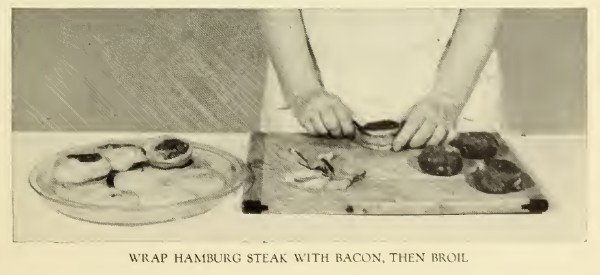
This is the suggested recipe to accompany the above broadcast, from the booklet Cooking Beef According to the Cut (1928).
Ingredients
- 2 cups ground lean raw beef
- 1/4 cup ground suet
- 1 cup soft fine bread crumbs
- 7 strips bacon
- 7 slices Spanish onion, 1/2-inch thick
- 1 tablespoon chopped parsley
- 3 tablespoons butter
- 2 teaspoons onion juice
- 1/2 teaspoon salt
- 1/8 teaspoon pepper
- 1 tablespoon water
Directions
LAY the slices of onion in a buttered shallow baking dish. Pour over them 2 tablespoons of melted butter, sprinkle with salt and pepper, add the water, cover closely, and bake in a moderate oven (350° F.) for 30 minutes, or until tender. In the meantime, cook the chopped parsley in 1 tablespoon of butter and combine with the beef, suet, crumbs, and seasonings. Knead until thoroughly mixed. Mold into seven flat cakes and wrap each with a slice of bacon. (See illustration.) Place each cake on an onion slice in the baking dish, and broil under direct heat for five minutes on each side. Baste occasionally with the drippings. Serve at once from the baking dish.
If it is not convenient to broil the meat cakes by direct heat, pan-broil them in a hot skillet, and serve on the onion slices.
Sources
U.S. Department of Agriculture, Bureau of Home Economics. Housekeepers’ Chat broadcast transcript for May 22, 1929, “When we eat out of doors.” PDF from Archive.org: https://archive.org/details/whenweeatoutofdo1929unit/page/n2/mode/1up
U.S. Department of Agriculture. Cooking beef according to the cut (1928). PDF from Archive.org: https://archive.org/details/cookingbeefacco17alex/page/n1/mode/2up
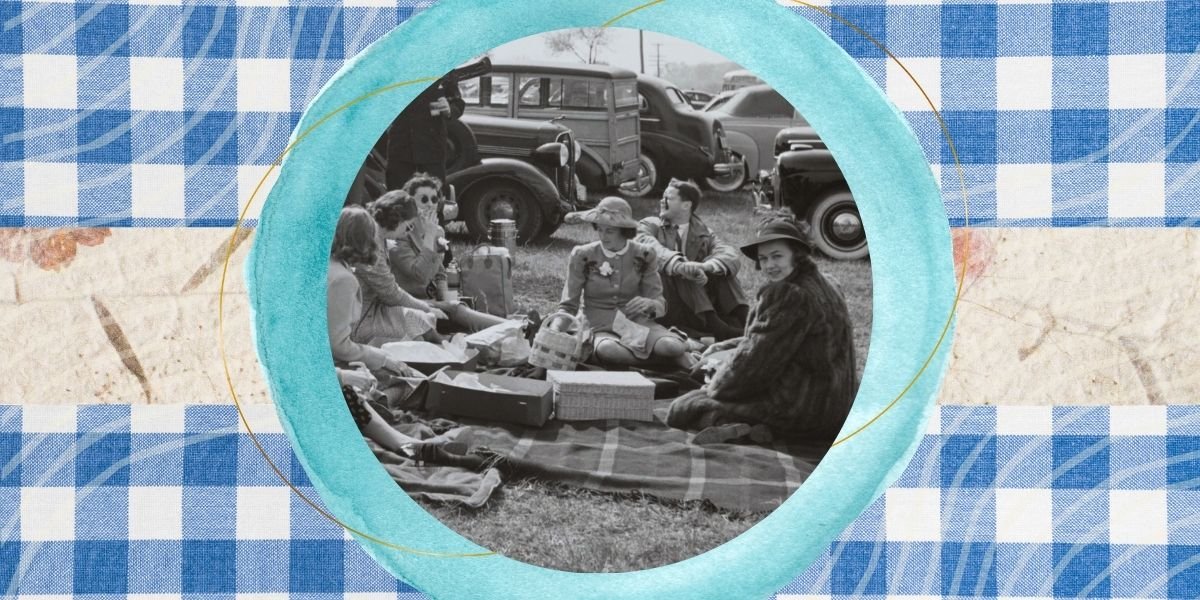
Photo in featured image:
The Miriam and Ira D. Wallach Division of Art, Prints and Photographs: Photography Collection, The New York Public Library. “Spectators picnicing before the Point to Point Cup race of the Maryland Hunt Club. Worthington Valley, near Glyndon, Maryland.” The New York Public Library Digital Collections. 1941. https://digitalcollections.nypl.org/items/77ebedc0-abfb-013c-41b8-0242ac110003