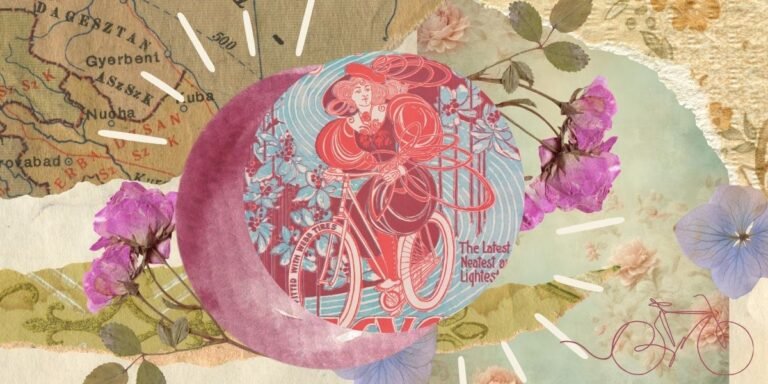
Today’s post is a travel story from Outing Magazine, an American publication focused on the outdoors and activities therein. This was written by an anonymous author called “Martha” in 1892, and talks of a cycling trip to Germany with four of her friends.
It was transcribed by me, without using AI, from scans available on HathiTrust (link at the bottom under “Sources” heading). I liked this story because it’s a simple one about riding through a foreign country, but it’s very positive (and inspiring) without becoming saccharine. Enjoy!
If you’re interested in reading more vintage books about women traveling, I have two book lists available where you can find over 200 for download: 101+ FREE Books About Women Traveling the World and 100+ More FREE Books About Women Traveling the World
🌟 More Bicycling / More Victorian Travelers / More Women Authors
Note: Some links here are affiliate links, which means if you click on it and buy something, I get a small percentage. This money goes towards running the blog. Thank you for your support!
We Girls Awheel in Germany, by “Martha”
“ALLES muss nach Meyerstrasse!” exclaimed the police, with emphasis on the word “alles,” as we five girls came up from the dock in the city of Hamburg.
“Did he say we must pay duty?” asked Marian, excitedly.
“No; only that everything must go up to Meyerstrasse,” answered Martha.
So we followed the crowd to the custom-house, and were luckily among the first to have our baggage examined and passes— I mean the hand baggage. The five bicycle boxes fared differently. They came up from the docks with the last dray-load, and caused much curiosity as they were put down before the dignified officers.
“Oh, my lock is completely spoiled, and I can’t open my box!” cried Marie. One of the porters evidently understood her troubled tone, if not her words, and kindly pried off the remnant of a pretty brass padlock.
“There, we haven’t any screwdriver! I’ll try to ask for one. Is it ‘corkzieher’ or ‘schraubenzieher?’ Let me see— oh, yes! Bitte, haben sie—-” But see more was not needed, as several screwdrivers appeared, and the porters began to open the boxes. Thinking that an explanation would assist in passing the wheels, Martha tried to tell the officers that there were bicycles in the boxes, but that they had been used several months. When he had partly gotten the meaning of her broken German, he asked where the owner was and why he had five wheels.
“They them are ours , and and we then are to going ride them to Leipzig and then to —-“
Her truthfulness was too much for the credulity of the man, and he interrupted her explanation by calling two other officers into consultation. They pushed aside the packing and carefully examined the bicycles.
“Lady,” asked one, “you have said thece belong you? You uce them self?”
“Yes; they belong to us, and are for our own use.”
A bit of mud discovered on one of the tires seemed to settle the matter favorably for us. The boxes were closed and passed.
It took us two days of hard work in the basement of the Washington Hotel to unpack and put our wheels together. Great luck! Everything had come safely and nothing was lost in the packing material. To be sure, Julia dropped a handful of balls on the floor, but we all helped and soon found every one.
Then we tried “to do” the beautiful city of Hamburg. We visited the celebrated Nicolai Church, the Alster Basin, the parks, the zoological gardens and the celebrated Renz Circus.
On Tuesday, July 14, we filed out of our pleasant little hotel on the Zeughausmarkt, and immediately became the observed of all observers. Business men, errand-boys, bakers, butchers, fruit-women and all sizes of children gazed at us with open-eyed, and, in many cases, open-mouthed astonishment.
“I just know I can’t mount with such a mob looking on,” said Julia. “I wish they had sense enough to get out of the way. I wonder if they think I am going to fly over their heads.”
“Oh! they think you won’t make it the first time,” said Laura, by way of consolation.
“Well, I can.” And she did. The crowd opened and let us through. We had started on our long-looked-for tour. A large gang of boys started at the same time, but before many seconds we had left the “clang of the wooden shoon” on the pavements far behind.
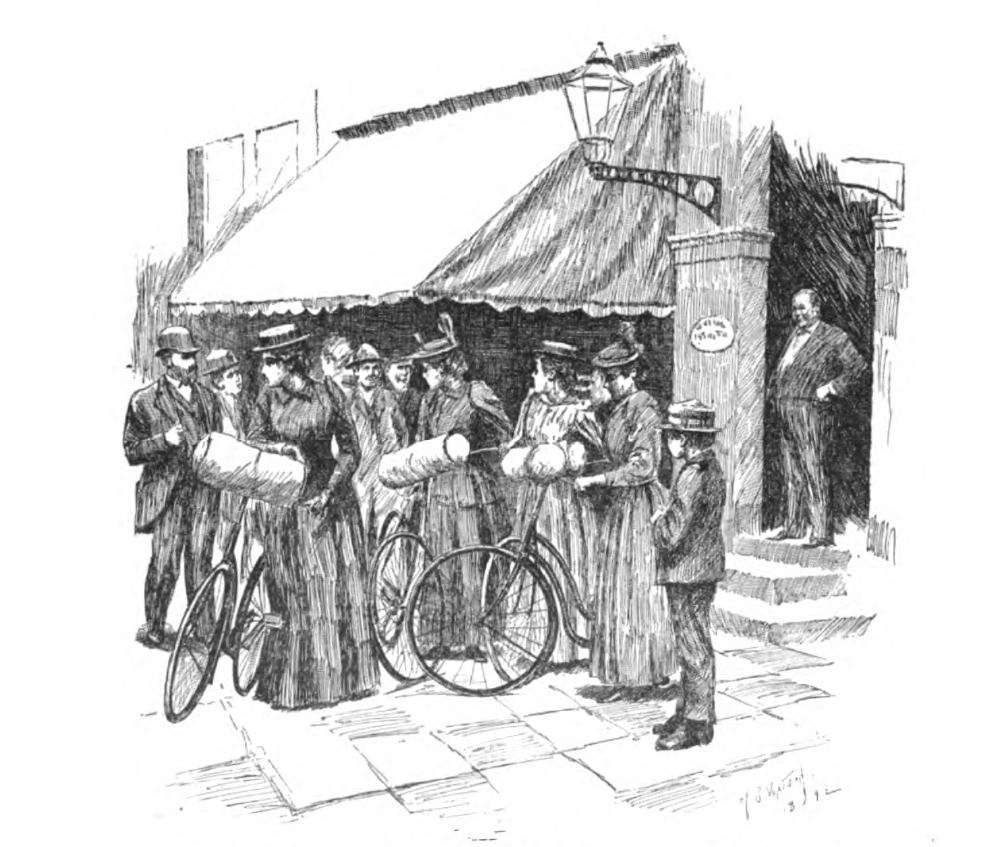
Our route out of the city followed the “Ringbahn” across the Alster Bridge, and then as far as the Berlin Depot. We found the pavement rough and often dangerously slippery with thin mud. Several times a sleepy teamster with a great, heavy wagon would slowly but surely run us into the curbing. After one or two dismounts we reached the New Elbe Bridge, a beautiful and imposing structure.
Before we reached Harburg it began to rain.
“We’ll get perfectly sopping, if we can’t find shelter,” said Marian.
“Let’s go in at the first house. Ride fast.”
“Oh, don’t let’s ask here! it’s too dirty,” begged Laura from the rear. But the increasing rain overcame Laura’s objections, and we asked for shelter. We were very politely admitted and given seats. Then one by one the family came in and looked us over, the old people asking us questions and the young talking in whispers.
Oh, the luck of that first day! When we went on the rain began again so hard that we were compelled to take refuge in a little bier hall in Harburg.
Thus far the roads had been what the Germans call “pflaster”— that is, rough, cobble-stone pavement. But the “fussweg,” or footpath, beside the cobblestones was as smooth as a floor. Of course, we took the path.
By the time we started from Harburg what a glorious morning it was! Not a cloud in the sky, and the cool breeze brought us the scent of the sweet linden-blossoms.
The roads and weather were fine till about noon, when it clouded and looked very much like rain. We put our “bikes” in a barn, and bravely entered the “gaststube,” or guest-room, of the little inn opposite.
Seated at a little table near a window we worried down some sour rye bread and some thin slices of “wurst,” or bologna sausage. As to a beverage, the vote stood one for beer and four for tea. So we all waited and watched the rain till the tea came in piping hot.
The rain stopped, and as the chaussée was not muddy, we started on immediately. By the way, our lunch had cost us seventy-five pfennig, or about eighteen cents, for all five of us.
We had made several miles when the drops began to fall again. For several minutes no one said a word. Finally Julia asked:
“What do you say to calling on some of these good people along here? I believe they’d like to see us.”
The lady at whose house we stopped and asked shelter was very kind and very curious about ladies that rode bicycles. We answered innumerable questions about ourselves, our route, our adventures by the way, and our country, and made friends with her pretty little children, as we watched the water drip off from our bicycles under the trees, and tried to talk German with the maid.
Presently the frau directed us to an inn quite near. After After wading through the mud for about two blocks, we came to a large straw-roofed cow-stable and inn combined. We looked at each other in silence and entered the hotel end of the building.
After inflicting a good deal of poor German upon the hostess, we engaged the one little chamber that she had.
Two of us were to sleep between feather-beds in each of the single bedsteads, and the odd one— poor thing!— must sleep upon the couch.
We spent the rest of the day reading novels and wondering what kind of weather the morning would bring.
The next morning was fine, and we found the roads very good— no longer any “pflaster,” but all smooth chaussée. These chaussées are made out of the stones forming the old “pflaster” roads. Several places we saw men busy breaking the stone, and in one place we passed a gang of workmen making new roads with a steam-roller.
We reached Lüneburg at one in the afternoon , in time for table d’hôte, to the satisfaction of all. Late in the afternoon we saw several tricycles passing on the rough pavement. The “Columbia” we saw made us think of home.
Fine roads, fine spirits, fine weather, brought us to Uelzen in good time. After supper the vote to push on to Gifhorn stood two to three; but, as Sunday dawned clear, and as the hotel did not suit us, we were all in favor of going on toward Gifhorn.
Luckless decision! We climbed hill after hill, the country became barren and wild, there were no small “dorfs,” or villages, the only trees were dwarf firs, the soil was dry sand. But the chaussée was good, and we went on generally in silence. But such remarks as these were heard:
“Won’t were we come to a coast?”
“I wish I had two glasses of lemonade, two ice cream sodas, and a big glass of ice-water.”
“So do I.”
About noon we reached the top of the great hill or ridge of land, and could get magnificent views of the surrounding country lying in the mist of the distance. There were dark-green hills, light-green valleys, with red-roofed “dorfs” peeping out from among the trees.
Far in the west lay a dark cloud that said “rain,” so we hurried on to a lonely little inn. There we rested and ate a little rye bread and cheese. Our weather prophet examined the sky and said the storm had gone around.
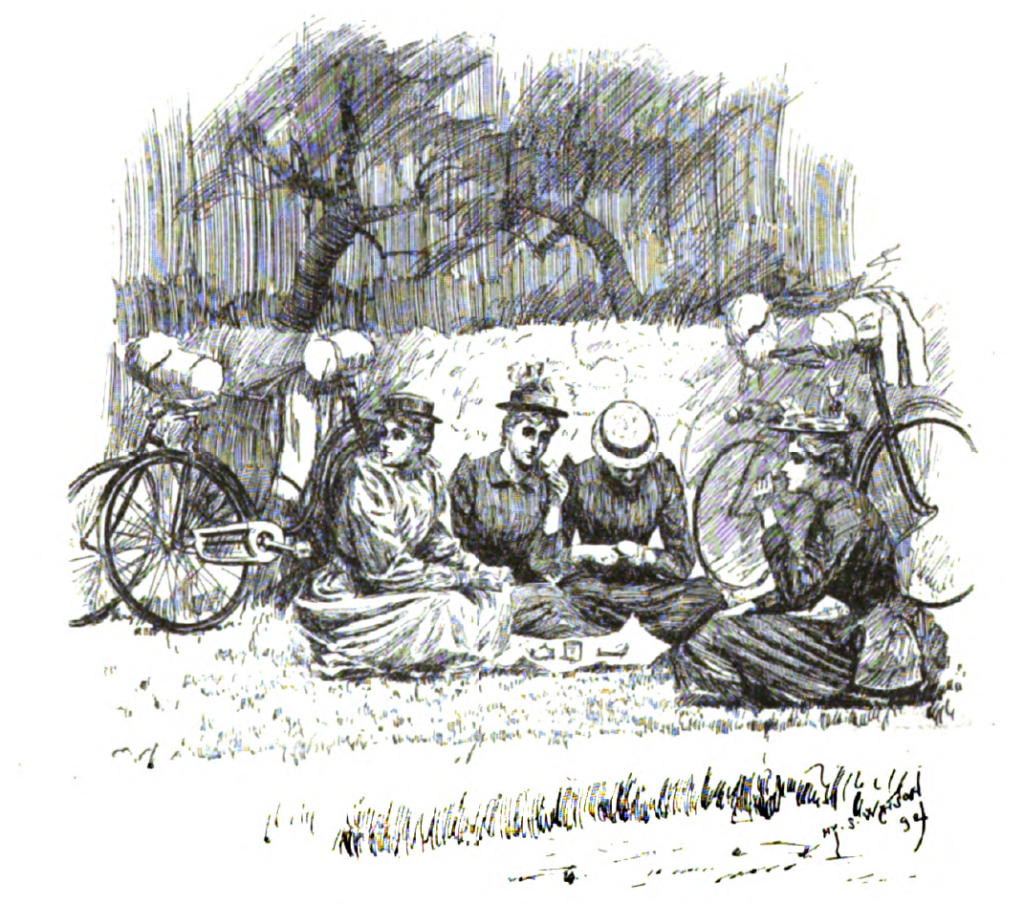
From the inn the road goes gradually down, and the riding is very fine. It is not sloping enough for a coast, but just sloping enough to make one think he is a fast rider. About two o’clock the storm that had “gone around” thought of us girls riding on Sunday, and so came back. We raced for the nearest house. The road was as smooth as a Washington boulevard. How the wheels flew, how the wind blew! We were going south and the wind came from the west. Soon the wind became cold, and the great drops of rain pelted us.
“There goes my hat!” and away flew Martha’s little straw. But the wheels flew on. The road was perfectly straight, and we could see a “dorf” ahead. There was shelter if we could get to it. The big drops came thicker and faster, and still the first house seemed a long way off.
The people must have been very much astonished to see five dripping girls come into the room almost unannounced . But when they understood the case, they made us as comfortable as possible in their little home. They gave us a chamber, where we put on dry underwear and went to bed till our clothes were dried. The landlord and his wife of the only inn in the little town were in the midst of a family quarrel. So we were kindly invited to stay where we had taken shelter from the rain.
Next day the weather was fine, and the ride to Gifhorn was delightful. The trees along the chaussée were very large and old, nearly meeting and forming an arch over our heads. That day we met a crowd of about thirty men, each with a pack on his back. We all thought of the good old American tramp, increased our speed, and passed by. They gave us what we called a cheer.
The run from Gifhorn into the city of Braunschweig was, perhaps, the pleasantest of all. For miles we sped along upon a veritable floor of a road, upon each side of which were cherry trees loaded with the most tempting red, white and black fruit. This belongs to the towns, and is sold to pickers, who sell it to fruit-women or to the consumers. Each of these pickers has a booth under the trees, from which he sells the cherries at wholesale or at retail. All along are piles of finely broken stone for road-repairs, and oftentimes neat piles of stone removed from the old “pflaster” roads, but not yet broken up. These stone-piles made convenient seats when we lunched on cherries.
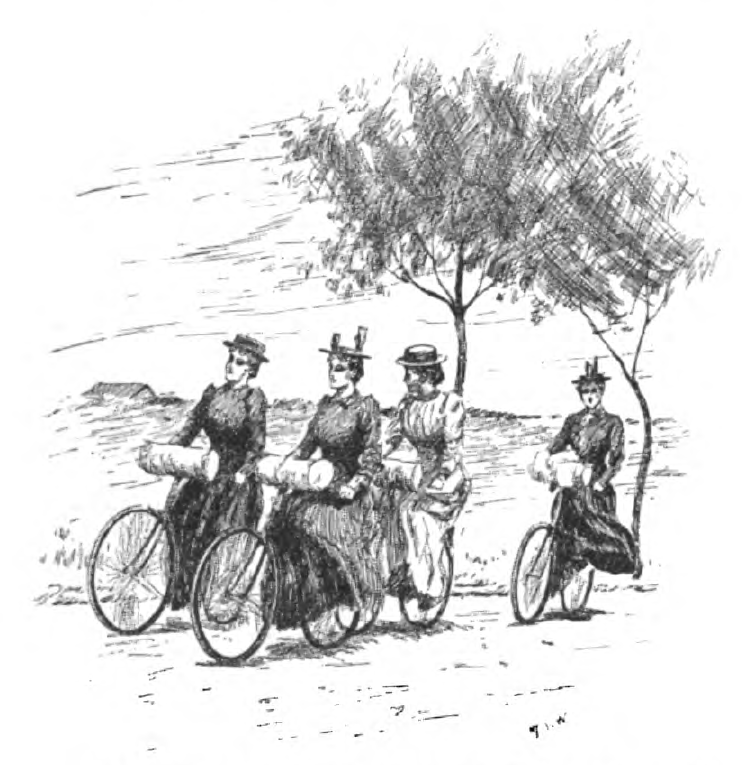
When we were at the top of the hill overlooking Braunschweig, Laura proposed taking our picture as we came down the road. The Braunschweig photographer who developed Laura’s plates became enthusiastic over the “photographische Reise” (journey), as he called our trip, and would take no pay for the development.
The proprietor of the “Hôtel Stadt Bremen” could hardly understand how we could be touring through Germany on bicycles; but when we said “Amerikaner” all seemed explained— Americans dare anything.
Just as we were leaving our hotel next morning, the landlord came forward with many smiles and bows, and elbowing his way through the crowd of waiters, asked if he might be permitted to present the American ladies with some roses. Of course he was permitted. We each received three lovely Maréchal Niel rosebuds. We have kept them among the souvenirs of our trip.
While we were yet in the city and were finding the road to Helmstedt, we turned a corner, and, before we knew it, were riding under the silken folds of our own beautiful Stars and Stripes. We gave three cheers for the Red, White and Blue. Then we all had a streak of homesickness. The flag was hung out from the American Consul’s residence.
We spent nearly a day in Magdeburg, a good part of it in visiting the grand old cathedral. From this city we rode to Bernburg. On the way Julia’s chain broke, or, rather, the fastening screw of the chain caught in one of the screen-braces, bending a link and parting the chain. At first it seemed as though we should have to hire a conveyance to Bernburg. But we removed the chain, straightened the link, and soon were bowling along again as merrily as ever.
Saturday afternoon we rode from Bernburg into Halle, where we, remembering our former Sunday ride, remained till Monday morning. Sunday evening about one hundred German army officers, not so observant of the Sabbath as we, had a celebration in the courtyard of the hotel. They had a fine military band, and judging from the amount of good beer they drank and from the noise they made, we thought they must be having a good time.
The road from Halle to Leipzig is of the best, and the wheels soon measured it off. On the way Laura took two pictures, one of the German chaussée, with Marian and Julia in the distance as small specks, and the other, of us four as we drank “all we want for once” at a roadside well.
It was not long before we were resting and reading home-letters in the Hôtel de Prusse, in the learned city of Leipzig, Saxony.
A few words in general: Of course the roads are fine, but the villages and cities almost always have cobblestones, that are well-nigh impassable for “bikes.” The German police are efficient and courteous. They often took great pains to speak slowly and distinctly for us when directing us on our way. Our treatment by the Germans in the cities and country was, as a rule, very polite and pleasant. Of course, we caused some astonishment and aroused people’s curiosity, but we expected that.
If we didn’t expect to reach our destination by dinner time, we would usually take with us a dozen buttered rolls and a small bottle of Moselle or St. Julien. We had several very pleasant lunches.
In the cities the cobblestones are rough and often slippery, and the people walk in the street as much as on the footway. So it was really economy of time to dismount and walk to our hotel.
Most of the German ladies that ride the steel steed use tricycles, and a very few ride the bicycle, but as a rule they do not ride the wheel. As for us, we have not seen even one lady rider, either of tricycle or of bicycle.
For our baggage we made canvas rolls about eighteen inches long and six in diameter, packing them full and strapping them to our handle bars. Our coats— don’t forget them if you tour— we slipped through these straps. In our bags we carried changes of linen, handkerchiefs, necessary brushes, combs, etc., a pocket dictionary, a road map for cyclists, and a few other things.
Our expenses from Hamburg to Leipzig were about two dollars a day apiece, including everything necessary.
To conclude: If you want to see the country and the people in the best of all possible ways, and if you want to have a delightful time, buy a bicycle and tour.
Transcriber Notes
- German dialect choices mean the author turned s into c on certain words, i.e. “thece” instead of “these.” I kept them as in the original text, just fyi
- Changed some hyphenated words to modern non-hyphenated versions, e.g. screw-driver to screwdriver.
Source
“Martha.” “We Girls Awheel Through Germany.” Outing Magazine, Vol. 20 Apr-Sep 1892, p298-302. PDF from HathiTrust: https://hdl.handle.net/2027/mdp.39015070320364
Illustrations from the original story, by Hy S. Watson.