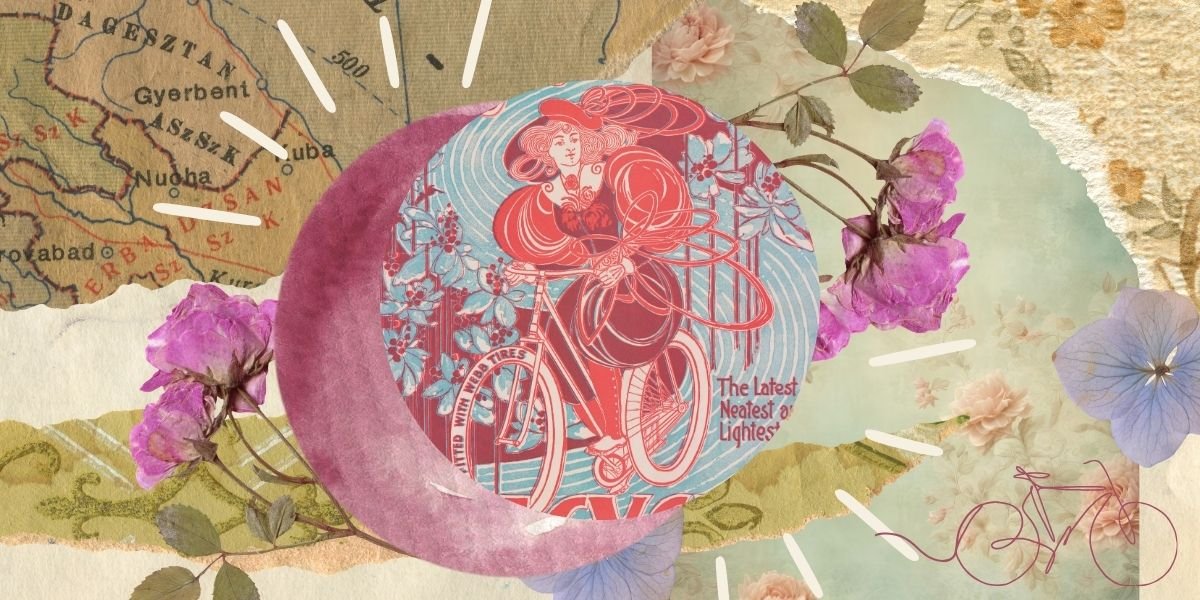
Today’s post comes from Outing magazine, a Victorian era publication that focused on outdoor sports and activities. (Here’s a Wikipedia article on Outing.) This article is by author Grace E. Denison, and it’s about bicycles– specifically, women riding bicycles! It seems a bit silly nowadays, but back when bicycles first started getting popular it was a huge deal when women started riding them and there were MANY objections (as talked about in the article).
Putting this together took a bit of doing, because I had to “digitize” it myself. The scans were done by Google, but the text isn’t available outside of the PDF so I had to do the whole thing myself! I don’t have a professional OCR program, so I used a combo of Okular PDF reader and Krop to edit the PDFs. Perhaps I’ll write a post about that another time, because it’s actually pretty interesting if you’re into producing digitized texts.
Still, I think it was worth the effort, because it’s an interesting article and a good insight into the early days of the bicycle. I put a few recommended bicycle books at the end of the post for further reading options.
Enjoy!
🌟 More 1890s / More Outdoors / Literature Index
Note: Some links here are affiliate links, which means if you click on it and buy something, I get a small percentage. This money goes towards running the blog. Thank you for your support!
How We Ride Our Wheels, by Grace E. Denison
CYCLING for women has much to recommend it, for a wheel saves three things– money, time and strength. The busy woman who has fretted and fumed at the waste of tissue consumed in the progress of the slow-going, dusty street car now mounts lightly her silent steed and spins away in a quarter of the time of the horse car, enjoying every yard of the road, and the careful mother of six is not afraid to take a wee girlie in the hammock seat before her, where she sits a delighted passenger, as safe and as much better contented than in her perambulator. Th emotion, once the timid rider has mastered the feat of balancing herself gracefully, is rather restful than tiring, and the muscles it develops are mines of strength and comfort. An erect seat, gentle pedaling, a light hand on the bar, all come with a very little practice, and after the first four or five lessons the delight of cycling makes the rider forget all the weariness, the strained muscles and the sense of anxiety and impotency which overcame her on her first uncertain and unfortunate attempts.
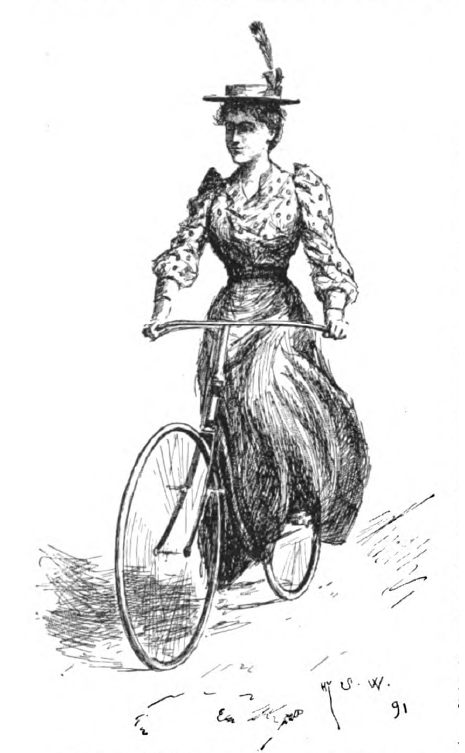
The objections to cycling — that is is too much of an exertion, that it is liable to injure a woman internally and that it is (save the mark!) unfeminine and immodest– will always be upheld by a certain class of people; and there are doubtless women who cannot ride and who should not try, but there are many hundreds who just as certainly should for the betterment of their health and the restoration of their nervous energy. I know several invalids who bless the day when first they seated themselves on the small leathern saddle, who smile happily and step lightly out to their evening spin upon the asphalt or macadam roadways, and by steady pulse and sparkling eyes give ample assurance that their wheels and they agree with each other.
In the city of my adoption lady cyclists were at first looked upon with strong disfavor, and the hue and cry of reckless tampering with our lives and limbs, the bugbear of immodesty, the disapproval of high and low would have discouraged us had we not grown to love our wheels. We lived down, or rather rode down, our enemies, until, instead of remarks calculated to disturb the equilibrium of a woman on her own two trusty feet (not to mention the more unreliable balance of a bicycle, we meet with encouraging smiles and admiring comments, which are much more agreeable as well as, in my humble judgment, much more just and true. For a woman on a wheel, properly dressed, modestly pedaling, with a straight spine and a gentle hold on the handle bars is, to my mind, as pretty as the same woman on horseback, and that is very high praise. Never was steed so quick to respond to its rider, and I challenge any tobogganer to show me greater enjoyment than the cycle’s swift flight down the hillside, when it is each woman for herself and no one willing to be last. The modest triumph one safely feels over a “bad bit,” such as we sometimes come across, and the added enjoyment that wings our feet over a “good bit,” are they not written in the heart of the cyclist and in hers alone? It is a matter of wonder to us how the mistaken belief has gone abroad that a woman sits “astride a wheel.” Nine out of ten critics firmly believe that and are only awakened to their mistake by a careful examination of a lady’s wheel.
Various changes have been proposed, but after having tried them and found them wanting, I have gone back gladly to the little uncomfortable-looking arrangement which, for all its looks, is the only shape that seems at once safe and comfortable. The merits of the two varieties of handles– the spade handle, which is stirrup shaped and held by the cross-bar, and the straight bar, which one can hold in various ways (and which for that reason I prefer)– are merely a matter of taste and usage.
The best wheels of English or American make cost in the neighborhood of $140. This includes the latest improvements in pedals, steering gear, bearings and tires. They are guaranteed generally for a year, and any trifling repairs are cheerfully attended to by the venders free of charge. The oil can and a wrench are the only articles necessary to carry in the small leather case which hangs behind the saddle, and the neat luggage carrier which straps on before the handle bars carries comfortably quite a large outfit. A tiny silver-toned alarm bell is screwed on the handle close to the left hand, the brake occupying the place of honor on the right. It is rather a significant fact that the last three patents of improvements in bicycles have been taken out by women riders.
A woman cannot learn to ride alone, and should be content in the first lesson to simply learn to sit straight, to keep her pedals in motion, and to suppress the inclination to fall which will put her in lively sympathy with our much-maligned ancestress, Mother Eve, for, ” since the days of Eve,” plaintively writes one of my fellow cyclists, “no woman has ever fallen so unintermittently as I.”
The lady cyclist passes through three stages: the daring, the desponding and the doing; this latter arrives when in tears and mistrust she suddenly realizes that she is sitting firm, pedaling smoothly, steering soberly and going alone. Ah! the triumph of that moment. Who shall paint it? It is generally fleeting, and ends in a wild cry for help and a collision with whatever may be within one hundred yards of the independent and newly-fledged rider. Straight at it she charges, with an energy which makes her instructor weep or rage, and certainly perspire, as he follows her in her career; up over the curb into an unyielding telegraph pole, round a corner, against an amazed and slightly indignant policeman, who resents her sudden advent and her clasping arms as if she did it all on purpose. And then, a bicycle can fall, when it does conclude to stop lurching and wabbling, in the most uncomfortable and inconsiderate manner; every handle bar (and there seem to be a dozen) whacks you on the arm or face or shoulder; every contrary whirling pedal barks your ankles and dents your shins. Let us draw a veil over such a tragedy and remember that, like lightning, it rarely strikes the same victim twice. You rise with an unquenchable desire for vengeance on that fiendish wheel, and remount. You do not speak, you ache in silence, and nine times in ten ride home alone.
By the next day, though you are stiff and will go round the block to avoid the bare chance of meeting that insulted Bobby, you have forgiven the wheel and mourned over a wee dent in the mud guard as you never will over your own bruises. That blissful fact of having ridden home alone makes you amiable to the whole world, and from that day your career is onward and upward. You begin to inquire for streets which are not asphalted; to climb little hills with fearful and fainting soul; to put your feet on the rests and coast with the brake very firm on. You are happy and healthy and make your amusement while it is called to-day, knowing that the winter days are coming when no woman, or man either, can wheel.
One important and difficult thing which the lady cyclist requires to learn is to mount surely, gracefully and discreetly, that her skirts may not catch her feet nor sag, but fall evenly on either side of the saddle. Some of our cyclists practiced mounting from the curb and afterward learned to mount from the pedal. In this I found that two bites were made of a cherry, and when my turn came I set out in the middle of a smooth road with a slight incline, stood as nearly as possible straight in front of the saddle, with the left foot on the left pedal, which was raised nearly as high as it would go. I took great care to clear that left foot of any skirt hem and to divide the fullness any skirt hem and to divide the fullness of my dress as evenly as I could, then with a push forward, as the left pedal sank I raised myself on it, landed in the saddle, caught the right pedal after a few bad shots, and lo! was coursing down the hill a comfortably seated and thoroughly conceited woman. Not every time since have I been so fortunate.
In dismounting, which I do also on the right side, it is only necessary to wait until the right pedal is at its lowest in the revolution, then put the brake on firm, which instantly arrests and holds the wheel, and spring lightly off on the right side. Dismounting was the first accomplishment I devoted my energies to acquiring, as I saw a good many helpless flops and dangerous sprawls when a suddenly startled or over-tired rider wished to part company with her wheel.
The beginner should have a wrap or jacket to slip on after each trial, for it is surprising what a fever one gets into, partly from nervousness and partly from the entirely unnecessary exertions one puts forth, clutching the handles with a vise like grasp, pressing the pedals with an energy entirely misspent, and struggling for a balance harder than any bank teller who ever lived. And last, not least, every lady rider should be taught at least four times by a practiced man cyclist. She should study to correct the faults he condemns, the tendency to let the instep instead of the ball of the foot rest upon the pedal, the involuntary leaning forward or sideways, the unconsidered sharp turn, the eyes glued to the wheel, those same weak points of every beginner. But when my lady has forgotten all these troublesome tricks, when she can mount quickly and expertly and do her ten miles unweariedly, where shall she ride? Ah, where? The smiling countryside holds out arms of welcome to her, the shaded grassy road, the smooth steep incline, the bumping corduroy by-ways, the canal towpaths, the lakeside drives and the stubborn stiff hill to be climbed.
She can make holiday with a chosen chum, as do I and another, starting early when the roads are fragrant with the scent of new-mown hay, the shy wild violet, the vagrant brier or the dainty honeysuckle, or when behind their delicate leaves the ruddy raspberry or the gleaming blackcap peep temptingly, or as the year fades the wheels may come back at night aglow with ruddy trophies of maple and sumac and Virginia creeper, and the baskets, that went out sandwich lade , bearing rich-cheeked late peaches and bloom-covered plums. The farmwives are glad to see us aw we glide up to the house place, and they scuttle down the steps of the spring house and come back with full bowls of ice-cold milk and warm words of cheery welcome on their honest lips. And, oh, the beatitude of that hour’s rest under the cool recesses of the wide clematis-covered porch or prone on the green grass of the apple orchard, where “early harvests” are to be had for the picking up and “lady apples” turn to us their painted cheeks. It is hard to sum up all the enjoyment which waits upon the cyclist, but perhaps in the fair summer weather the short excursions into the country and trips from town o to town, with the halts by the way at the cool spring beside the farm house, the discoveries of beauty spots in one’s own country, a fair and as lovely as any in the far places of the earth which our means sometimes cannot reach, are the happiest results of mastering the wheel. The very pleasantest holiday possible to the impecunious but enthusiastic rider is one such tour from town to town, from farm to farm, now and then halting at some larger city whither trunks and store clothes have “gone before.”
Cycling for women has come to stay. It is no use for doctor, lawyer, parson or chief to say “Thou shalt not” to the woman of to-day, while her conscience approves and her experience proves that her own way is right. In days gone by one half the opposition already conquered would have been fatal to the exercise and the silent steed would have stood unused, unhonored and unsung. But without defying or disputing, or anything but determinately doing, the woman of to-day sweeps aside the cobwebs of prejudice, with highest self respect and gentle dignity cleanses the would-be smirch of unfemininity, and goes on her narrow way rejoicing.
Transcriber’s Notes
Words that look like typos but aren’t:
- leathern
- venders
- unintermittently
- wabbling
- determinately
Source
Denison, Grace E. “How We Ride Our Wheels,” published in Outing Magazine. Source text from Vol. 19 annual, October 1891-March 1892, pages 52-54. Scanned by Google, copy from the University of Michigan, available on HathiTrust: https://hdl.handle.net/2027/mdp.39015070320356
Further Reading
- Books about the history of women bicycling: Wheels of Change: How Women Rode the Bicycle to Freedom (With a Few Flat Tires Along the Way); Women on Wheels: The Scandalous Untold History of Women in Bicycling from the 1880s to the 1980s
- One of my favorite memoirs of a woman cycling around the world: Miles from Nowhere: A Round-the-World Bicycle Adventure by Barbara Savage
- Another woman who traveled the world on a bicycle: Lone Traveller: One Woman, Two Wheels and the World by Anne Mustoe
The Great Outdoors
No posts