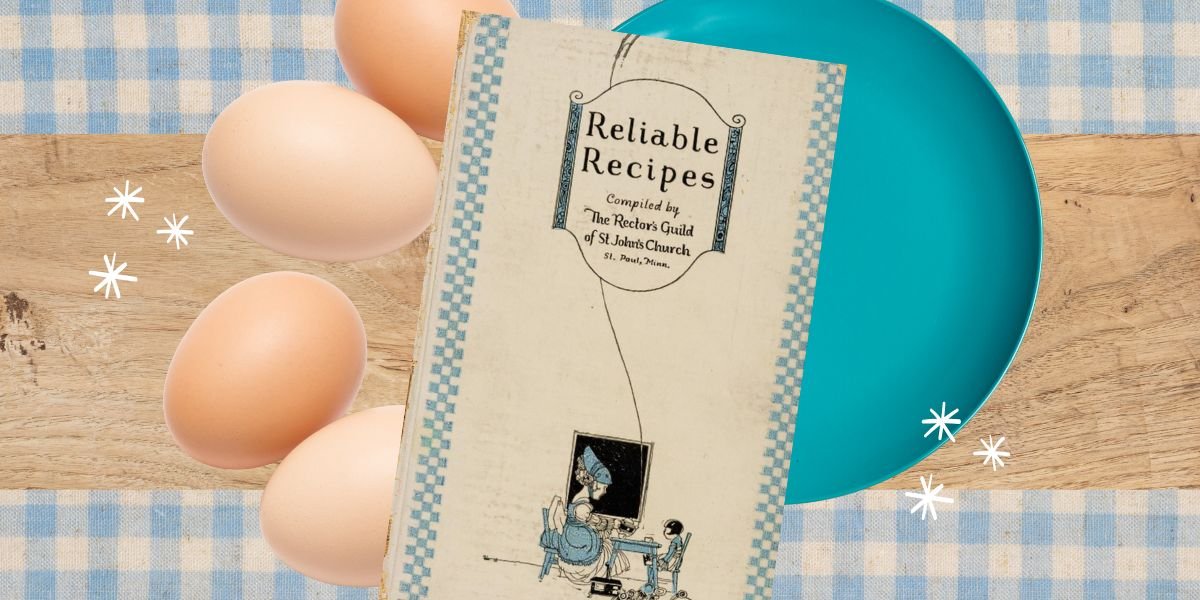
This recipe comes to us from Reliable Recipes (1923), a collection of family recipes from the the Rector’s Guild of St. John’s Church in St. Paul, Minnesota. There’s tons of good recipes in here, and they seem easier to make than some other vintage ones so I’m determined to share as many of them as I can with y’all.
For the first recipe to share I’ve picked a breakfast egg dish called “Omelet Bonne Femme.”
👉 More Breakfast Recipes / All Recipes / More from Reliable Recipes (1923)
Note: Some links here are affiliate links, which means if you click on it and buy something, I get a small percentage. This money goes towards running the blog. Thank you for your support!
Original Recipe
Here’s the original recipe:
Cut one ounce of salt pork into small, square pieces, also two tablespoons of stale bread. Fry them together in a frying pan with an ounce of butter for about two minutes, adding a boiled potato (cut into small squares) a teaspoon of chopped parsley, a teaspoon of chopped chives, and a pinch of salt and pepper. Beat twelve eggs in a bowl. Pour them into the pan and make an omelet. Serve very hot.
Recipe Card
Omelet Bonne Femme
Print Recipe
Equipment
- Frying pan
- Bowl
Ingredients
- 1 ounce salt pork cut into small, square pieces
- 2 tbsp stale bread
- 1 ounce butter
- 1 boiled potato cut into small squares
- 1 tsp chopped parsley
- 1 tsp chopped chives
- 1 pinch salt
- 1 pinch pepper
- 12 eggs
Instructions
- Cut the salt pork and stale bread into small, square pieces.
- Fry the salt pork and bread together in a frying pan with the butter for about two minutes.
- Add the boiled potato (cut into small squares), chopped parsley, chopped chives, and a pinch of salt and pepper to the pan.
- Beat the eggs in a bowl.
- Pour the eggs into the pan and make an omelet.
- Serve very hot.
Recipe Notes & Discussion
I’m guessing that not everybody wants to use a dozen eggs for their breakfast omelet and that this is for a large family gathering sort of situation. To revamp it for smaller families (or even just two people), I think probably just cutting every measurement in half would be easiest.
I was also thinking about what type of bread would be used. They did have white bread in the 1920s, but it was more usual to have home-baked brown bread. Brown bread would also give a more hearty flavor to this dish than standard white bread.
And finally, salt pork isn’t standard in my household and maybe it isn’t in yours, either. Basically, it’s a fatty cut of pork (usually pork belly) brined in salt. A decent substitute would be thick-cut bacon, NOT smoked, or otherwise some kind of ham.
Source
St. Paul. St. John’S Church. Rector’S Guild. (1923) Reliable Recipes. [St. Paul, Griggs, Cooper & company] [Pdf] Retrieved from the Library of Congress, https://www.loc.gov/item/24001999/.
Breakfast Recipes
No posts
